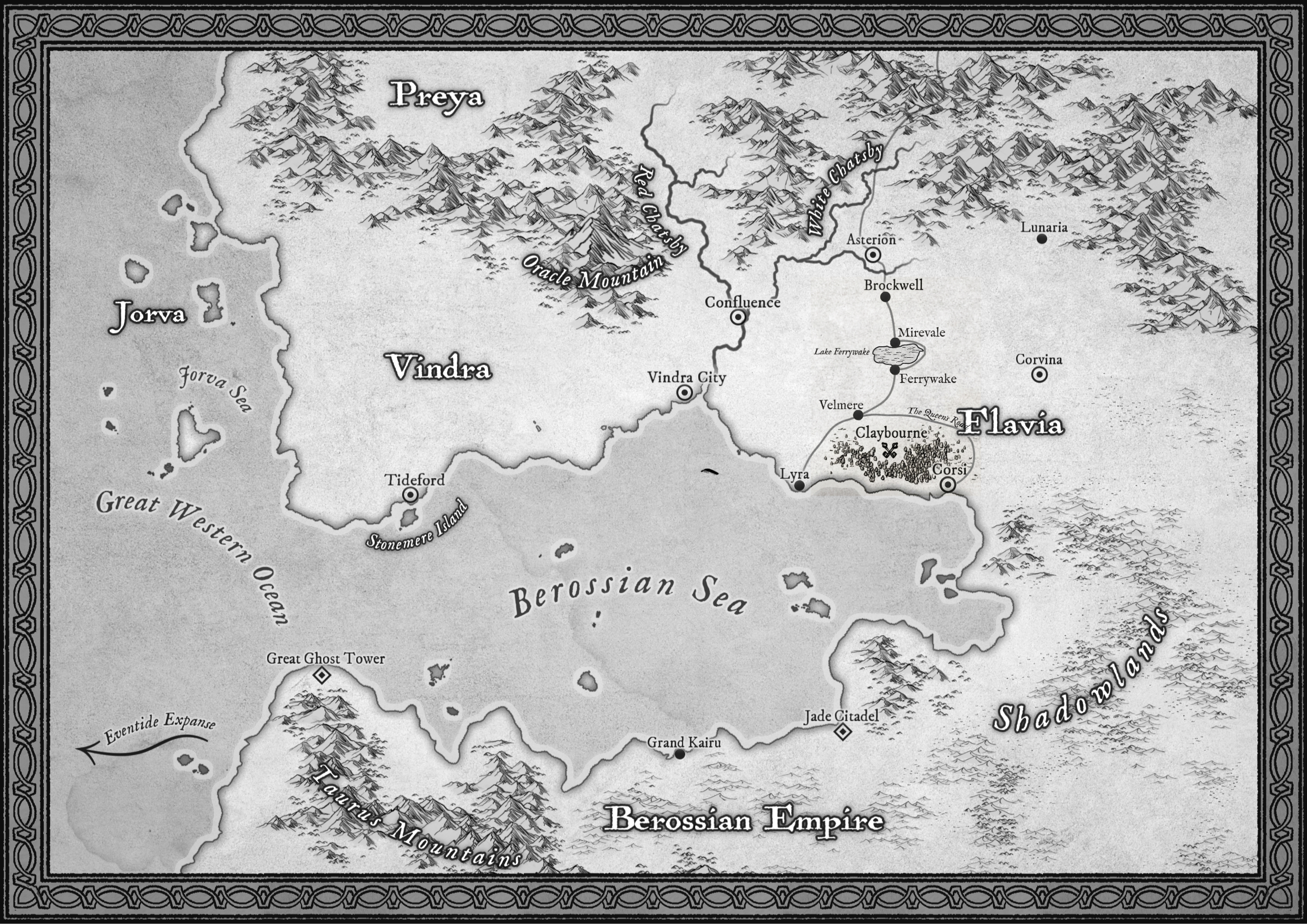
Map design by Alec McKinley (c) 2025
Fantasy author Nicola Zhang talks about the historical inspirations behind the Celestia trilogy, writing queer characters into historical fantasy, and balancing realism with the conventions of epic fantasy.!
What inspired the world of the Celestia trilogy?
Although the Celestia trilogy is second-world fantasy, a lot of the world-building is grounded in history. I wanted to create a world that felt like medieval Europe, but specifically without Christianity and the history of the Dark Ages. I started with something closer to ancient Greece and Rome and asked: what might these cultures look like if they had continued developing into something resembling the Middle Ages, but along a different religious path? From there, I drew on several specific periods of history. Vindra and Flavia are loosely inspired by England and France around the time of the Hundred Years’ War, while the Berossian Empire draws on the conflicts between European powers and what later became the Ottoman empire, touching on certain elements of the Crusades. But I wasn’t trying to reproduce a particular historical period with the names changed. They’re only starting points. I take aspects of real political structures and conflicts and then let them develop according to the history of this fictional world. I want it to feel as though these kingdoms could have developed organically over hundreds of years.What inspired the core gay relationship in the Celestia trilogy?
I’ve always been drawn to a particular relationship archetype that repeats itself throughout history and myth: the golden prince weighed down by tragic destiny, and the supportive, loyal companion who is the true hero without the glory. Achilles and Patroclus, Alexander and Hephaistion, and the BBC’s Merlin — at least the fannish queer interpretation of that particular Arthur/Merlin relationship — these were the pairings upon which Anden and River were modelled. Although almost never a key plot point, it was always vital to me that their relationship formed the emotional backbone of the entire story.How are queer relationships positioned in the Celestia Trilogy?
One of the deliberate differences between the Celestia world and historical medieval Europe is its attitude towards sexuality. The characters live in a violent world, and many of the men belong to a warrior class in which physical strength and traditional male attributes are valued. But because I was imagining something closer to a Greek cultural tradition developing into a medieval world, homosexuality simply isn’t considered a problem in this society. Nobody needs to have a coming-out narrative because the society doesn’t have certain assumptions that historical Christian Europe did. That doesn’t mean the world is socially progressive by modern standards. There are rigid hierarchies and restrictive gender roles, and the concepts of political marriages and dynasty-building continue to loom large in our characters’ lives. This allowed me to write a queer romance within an epic medieval fantasy without making homophobia the central obstacle — the characters have more than enough other problems.How historically accurate is the Celestia Trilogy?
It’s fantasy rather than historical fiction, so I have the freedom to invent things. But historical plausibility matters to me. One example is age. Most of the central characters in the Celestia Trilogy start the story around sixteen. That makes the series technically YA, but I didn’t choose their ages because I wanted to write about teenagers. I chose them because in a medieval society, someone of that age could already be expected to be involved in politics, war and questions of succession. They have to grow up much earlier than a modern sixteen-year-old would. The treatment of women is another area where I wanted the world to feel historically grounded. A royal woman such as Colleen, Mara or Telmaine has very little formal control over her own future, but throughout the trilogy, they continually test the boundaries of what they are allowed to do. This isn’t a high-magic world where a woman can suddenly gain enormous power because she gets a uniquely powerful ability. Instead, I was interested in how these ambitious and intelligent women might gain power despite restrictive social structures.The Celestia Trilogy contains a lot of war. Do you consider it military fantasy?
War is certainly a major part of the series, although I try hard not to glorify it. Throughout the books, there are people who wage wars for their own ends and others who are forced to respond to those wars. Some characters fight because they’re defending their homes or trying to protect other people, not because they have any desire for conquest. So the books contain some epic battles, most of which are inspired by real historical battles ranging from the ancient world (Gaugamela, Cannae) through to the middle and high Middle Ages (Agincourt, the Siege of Malta), but I’m interested in what happens around the battles as much as the battles themselves: who benefits from it, who actually has to fight it, and what happens to those people afterwards. There’s a campfire scene towards the end of Queen of Blood that pays homage to Shakespeare’s Henry V, which sums up that core idea for me. Even more so than Anden’s subsequent battle harangue, which was very much based on the St Crispin’s Day speech.What readers might enjoy the Celestia Trilogy?
The tagline that has most resonated with readers is “BBC’s Merlin meets The Last Kingdom but gay”. It’s a coming-of-age story, but it’s also about warfare, succession, religion, family and the ways individuals get caught up in much larger political events. There are multiple points of view and large-scale battles, but the emotional heart of the series is its characters and their relationships, including a central gay romance. The fantasy elements are deliberately restrained, with no overt magic. Whilst there are supernatural elements, I wanted to create a world where it’s possible to have a scientific explanation for everything. So if you enjoy historical fantasy, queer characters and stories where personal relationships unfold against much larger conflicts, that’s probably the intersection where the Celestia trilogy sits.